What is it?
What it is: nicotinamide adenine dinucleotide — a molecule present in every cell. It is not a peptide: it contains no amino acids and is built from two nucleotides. It is sold alongside peptides because it too is given by injection and drip, and it is offered by the same clinics and sellers.
Status: we found no approval as a medicine in the US, the EU or Russia. In the US, drips are prepared by pharmacies on prescription — this is permitted on a provisional basis while the FDA evaluates the substance.[3] The "precursors" NMN and NR are sold as dietary supplements.
When it appeared: discovered in 1906; several Nobel Prizes were awarded for research on it.[7] It is the "oldest" substance on this site, but the fashion for NAD+ drips only appeared in the late 2010s.
Sport: NAD+ itself is not prohibited, but outside hospital, athletes are prohibited from receiving drips and injections of more than 100 ml per 12 hours — regardless of what they contain.[4][5]
When a cell "burns" sugar or fat, electrons are stripped from the nutrients. NAD+ works as a shuttle: it picks them up, becoming NADH, and carries them to the mitochondria — the cell's "power stations" — where they are used to make ATP, the cell's universal fuel. The shuttle then returns empty, and the cycle repeats.
NAD+'s second job is as raw material for enzymes that consume it irreversibly: sirtuins (linked to the cell's response to stress and starvation, which is why NAD+ ended up in the "longevity" story), PARPs (which repair damaged DNA) and CD38 (an immune-cell enzyme that actively "eats up" NAD+, especially during inflammation).
The body makes NAD+ itself — from the amino acid tryptophan and from various forms of vitamin B3. So there are three different things on the market that should not be confused:
| Substance | What it is | How it is used | Status (US / EU) |
|---|---|---|---|
| NAD+ | the molecule itself | drips, injections; tablets and sprays also exist but are poorly absorbed | no medicine; pharmacy-compounded solutions on prescription — conditionally |
| NMN | an "intermediate", one step before NAD+ | tablets, capsules | supplement in the US since 2025;[27] not yet authorised in the EU[6] |
| NR | an "intermediate", two steps before NAD+ | tablets; in the US also drips | supplement in the US and EU |
The key point: most of the human research cited to explain the benefits of NAD+ was done with NMN and NR tablets, not with drips of NAD+ itself. Their results cannot be transferred to a drip.
Does NAD+ decline with age? Yes — this has been shown in skin, for example.[15] But how much and in which tissues depends on the measurement method, and no universal "age-related deficiency" that everyone needs to top up has been proven.[14] The claim from a video that "half of your NAD+ is lost by age 40" is not supported by research in that general form.
For those who want more detail: forms and synthesis pathways
NAD+ is the oxidised form and NADH the reduced form; the phosphorylated pair NADP+/NADPH is involved mainly in biosynthesis and antioxidant defence. Synthesis pathways: de novo from tryptophan, the Preiss–Handler pathway from nicotinic acid, and the "salvage" pathway from nicotinamide via the enzyme NAMPT — the main pathway in humans, and the one NR and NMN also go through. Formula C₂₁H₂₇N₇O₁₄P₂, mass ≈ 663 g/mol; CAS 53-84-9; UNII 0U46U6E8UK; DrugBank DB14128 (not to be confused with DB00157, which is NADH); international non-proprietary name — nadide.[25][26]
When did it appear?
What is it used for?
There are no officially approved indications. In research, NAD+ and its precursors are being studied in heart failure, Parkinson's disease, metabolic disorders and ageing.
Unofficially — mainly in wellness clinics: "anti-ageing", energy and mental clarity, recovery after exertion, hangovers and addictions, chronic fatigue and post-COVID symptoms. For none of these purposes is there a clinically proven effect of drips (see "What has research shown?").
A clinic drip, a "research" vial and tablets — what is the difference
The solution is prepared by a pharmacy on prescription. The FDA has not checked it for efficacy or safety; it lists NAD+ in "Category 1" — substances that are still under evaluation, and while the evaluation is ongoing pharmacies are allowed to use them.[3] Large pharmaceutical "outsourcing facilities" (section 503B of the law) may not make products from NAD+ — the FDA said so explicitly in a warning letter.[2]
Widely offered by private clinics. We could not find an approved NAD+ medicine, so what the solution is made from and how depends on the clinic.
A powder labelled "for laboratory use only". It has no intended use in humans and no independent sterility testing (see "ZPHC products").
Dietary supplements — different substances from which the body makes NAD+ itself.
If there are tablets, why drips?
Supporters of drips — in the reviews these are most often practitioners and the clinics themselves — believe that this way NAD+ enters the blood "directly and quickly". Critics reply that NAD+ given intravenously mostly breaks down quickly while still in the blood and is excreted in the urine, and does not get "directly into the cells".[8] At the same time, the studies in which NAD+ drips were tolerated worse than NR were funded by companies selling NR. In other words, the dispute is partly between sellers of different products.
What people expect from it and why it is popular
| Expectation | Where it comes from | What the data say |
|---|---|---|
| More energy, less fatigue | clinic advertising, bloggers; the most common impression in user reports is a surge of energy for a few days | user reports only; no controlled studies |
| Mental clarity, less "brain fog" | clinics, bloggers, user reports | user reports only |
| Slower ageing, "rejuvenation", better skin | longevity popularisers, "anti-ageing" clinics | not proven in humans |
| Fast recovery — after training, illness, flights, hangovers | wellness clinics, sports circles | no data |
| Help with addiction and withdrawal | "NAD clinics" since the 1960s | only old reports and observations without a control group |
| Relief of chronic fatigue, post-COVID symptoms, joint pain | patient reports, some practitioners | no data; individual cases |
| Better sleep and mood, fewer sugar cravings, weight loss | user reports, less often bloggers | user reports only |
| "Boosting the effect of peptides" | "peptide" circles, bloggers | no studies of such combinations |
Why it is popular. First, a simple story: "the energy molecule in every cell, which declines with age". The biology is correct, but the conclusion "so you need to add it from outside" is already an assumption. Second, a drip looks like "real medicine"; according to the authors of user reports, a session costs from a hundred to several hundred dollars or pounds — many times more than a month's supply of tablets. Third, the effect is "felt" immediately, and many people take this as proof that it works. But strong sensations during a drip are mostly side reactions (see "Possible risks").
What has research shown?
In animals
In mice, raising NAD+ (more often with NMN or NR) improved mitochondrial function, metabolism, muscles and blood vessels in models of ageing and disease.[16][17] But the lifespan extension was not reproduced: in an independent test, NR did not change the lifespan of either male or female mice.[18] According to a systematic review, the benefit is more consistent in rodents than in humans, and it does not predict the effect in people.[13]
In humans: NAD+ itself
| Study | Participants | Result | Caveats |
|---|---|---|---|
| Grant, 2019 | 11 healthy men (8 — NAD+, 3 — saline), drip | for the first ~2 hours blood NAD+ does not rise, then it rises together with its breakdown products; a notable proportion is excreted in urine; there were no side effects[8] | only the fate of the substance was studied, not benefit; funded by a company linked to NAD+ therapy |
| Yu, 2025 | 180 patients with heart failure, China; NAD+ or placebo | after one month, the heart's pumping strength (ejection fraction) rose more than on placebo; fewer hospitalisations over six months, but the difference was not significant; side effects were isolated[9] | a single hospital; the strongest evidence in favour of NAD+ — but in heart disease, not for "energy" |
| Reyna, 2026 | 14 wellness-clinic clients (6 — NAD+, 8 — NR) | all six on NAD+ had cramps, nausea, vomiting, a rapid pulse and chest pressure during the drip; these passed after it ended[10] | very few people, no placebo; funded by a clinic chain that sells NR drips |
| Preprint, 2024 | healthy adults; NR, NAD+ and placebo drips | NAD+ was tolerated worse than NR, and white blood cell counts rose after it[11] | not peer-reviewed; funded by an NR manufacturer |
| Kornilov, 2026 | 50 healthy people aged 45–75; a special oral form or placebo | NAD+ inside blood cells rose, but not in plasma[12] | a patented form, not ordinary capsules; some authors are linked to the developer |
Addictions. Drips have been used since the 1960s, but there are no high-quality controlled studies. A 2024 description of 50 patients reports reduced cravings and anxiety, but NAD+ was given there in a mixture with other substances and without a control group.[23]
For comparison: precursors (these are not NAD+)
- NMN increased muscle insulin sensitivity in women with prediabetes.[19]
- NR in Parkinson's disease (30 people): brain NAD+ rose, improvement was moderate; a large phase III trial is still under way.[20]
- Niacin (vitamin B3) improved muscle function in patients with a rare mitochondrial myopathy.[21] Bloggers often cite this study as proof of the benefits of NAD+, but it involved niacin in seriously ill people, not NAD+ in healthy ones.
Reviews
A 2026 systematic review (113 studies, 33 of them in humans): raising NAD+ has "clear biological activity", but its efficacy for anti-ageing and wellness is not proven. NR and NMN tablets reliably raise blood NAD+ and are well tolerated, but their effects on endurance, metabolism and blood vessels are contradictory. The authors found no adequate controlled studies of NAD+ drips or injections for anti-ageing at all.[13]
What research has not yet shown
- that NAD+ or its precursors extend human lifespan or slow ageing;
- that a drip is better than NR or NMN tablets on any real outcome;
- that drips help with addictions, hangovers, chronic fatigue or post-COVID symptoms;
- how safe regular drips and injections are over months and years;
- whether subcutaneous injections, sprays and ordinary NAD+ tablets work — there are almost no data.
What people who have used it say
Personal experience is not proof. Most authors received drips at private clinics; it is impossible to check what was in the solution. Reddit posts were checked manually; videos were chosen at random. Doses, infusion rates and regimens are not given.
A series of drips, US: "wow" — energy, clarity, daytime alertness, strongest in the first 2–3 days after the procedure. The author wonders whether the effect is short-lived; the main downside is the price. With a fast drip — an anxious feeling in the stomach.[29]
Psoriatic arthritis: after a month of drips, walks without limping and joints don't hurt. The author writes: "too good to be true". The period is one month, and arthritis comes in waves; the author stopped the prescribed medicine on their own — such decisions should only be made with a doctor.[30]
Three months of injections, video blog: mild cramps, fewer sugar cravings, slightly better mood; a long-standing pain in the hand went away (no proven link). On rejuvenation — "three months is too short". Considers NAD+ tablets and cosmetics useless: "there's no research".[35]
A drip in the EU: at a fast rate — chest pressure; outcome — "a slight improvement in clarity, no energy boost". The author already takes NMN.[31]
NR tablets vs a drip: NR gave noticeable energy; the drip — "not sure", plus stomach cramps. Proposes a hypothesis: NAD+ outside cells is a "danger signal" for the immune system, and the body responds with a defensive reaction rather than "topping up stores". Describes himself as an enthusiast, not a biochemist; the hypothesis is untested.[32]
Postural tachycardia syndrome: even with a very slow drip — tachycardia, heartburn, dizziness; in the evening had to take medication for palpitations. Complains that the procedures are mostly offered by cosmetic establishments pushing extra services.[33]
A temperature of 39.6 °C: an hour after a drip at a naturopath's — a sudden fever, brought down with an antipyretic; afterwards, according to the author, a strong surge of energy. A sudden fever after a drip is exactly the kind of reaction the FDA described when NAD+ solutions were contaminated with bacterial endotoxins; whether that was the case here is unknown.[34]
What specialists say in videos
The authors' personal opinions. Advice on use and doses is not given.
NAD+ is "charging the battery", peptides are "updating the system". She herself takes NMN capsules. "We don't yet know whether NAD+ slows ageing"; the memory data come from mice. She warns that most peptides are not FDA-approved.
Explains the pathway "vitamin B3 → NMN → NR → NAD+"; starts patients on NR or drips, then switches them to cheap nicotinamide. Warns about nervousness, palpitations and poor sleep with excessive amounts.
Unpleasant sensations during a drip — cramps, nausea, chest pressure, a rapid pulse — are described by many authors, but not all. They depend on the rate and usually pass after the procedure. Opinions on the result differ: from "wow" to "no energy at all", and several people note that the effect lasts a few days. Hardly anyone knows what was in the solution, and expectations of an expensive procedure are high, so user reports cannot separate the action of NAD+ from the expectation effect.
Possible effects
Possible risks
Reactions during a drip
Abdominal cramps, nausea, vomiting, diarrhoea, chest pressure, rapid pulse, flushing, headache. They depend on the rate and usually pass after the drip ends. In a small 2026 study they occurred in all six people receiving NAD+;[10] in a 2019 study, in no one.[8] Nobody knows the overall frequency.
Quality and sterility of the solution — a proven risk
- Food-grade NAD+ in injections. In 2024 the FDA warned that such raw material was being used for solutions; patients reported severe chills, shaking, vomiting and weakness, and some needed medical care. According to the FDA, this resembles contamination with endotoxins — bacterial fragments that cause fever and shock.[1]
- A Class I recall of a batch (US, 2025). Three patients were hospitalised with low blood pressure, shaking and chills after NAD+ injections from a single batch; endotoxins were found in an unopened vial.[2][28]
- "Research" vials — as a rule, they have no independent sterility or endotoxin testing.
The procedure itself
A drip is a medical procedure: vein inflammation, infection and errors in the composition of the solution are possible. The risk is higher without a medical examination and monitoring, and user reports describe "two-minute" consultations as well as drips at beauty salons.
Theoretical risks (no direct data)
- Tumours: cancer cells also need NAD+, so there is concern that raising it could support the growth of an existing tumour. This is a hypothesis based on laboratory data.
- Methylation: the body eliminates excess nicotinamide by using up "methyl groups" that are needed for many processes. Not clinically proven.
- Long-term safety and drug interactions have not been studied.
NAD+ is not a peptide but a small molecule, yet the risks of the injections themselves are shared with peptide medicines. Even peptides that have completed full clinical trials and are sold as medicines have side effects related specifically to injections. For example, for tirzepatide (Mounjaro, Zepbound), according to the FDA label:[39][40][41]
- injection-site reactions (redness, itching, induration): 3.2% vs 0.4% on placebo;
- allergic reactions: 3.2% vs 1.7% on placebo; rare cases of anaphylaxis and angioedema have been described after market launch;
For an approved medicine, these risks have been measured in thousands of people, and manufacturing is overseen by a regulator. No such data exist for NAD+, so the frequency of such reactions is unknown. On top of that come the risks of unlicensed manufacturing: contamination, errors in the amount of substance, lack of sterility. More on the tirzepatide page →
Contraindications / who should be especially cautious
There is no official prescribing information. Below is who is usually excluded from studies or for whom the risk is theoretically higher.
- Pregnancy, breastfeeding, children and adolescents — no data.
- Cancer, including in the past — a theoretical risk of supporting tumour growth.
- Heart disease, arrhythmias, low blood pressure — a rapid pulse and chest pressure have been described during drips. At the same time, in the heart failure study the drips were given under medical supervision without serious problems.
- Postural tachycardia syndrome, a tendency to faint — user reports describe drips that were tolerated badly.
- Severe liver and kidney disease — such people were excluded from studies.
- Weakened immunity — primarily because of the risk of a contaminated solution.
- Athletes — drips of more than 100 ml per 12 hours outside hospital are prohibited.
- Anyone on regular medication — especially if they want to replace prescribed treatment with drips.
Individual clinical cases
After a course of NAD+ drips, the patient's symptoms decreased, and ultrasound showed no active joint inflammation. The authors themselves stress that a causal link cannot be established: she had previously been treated with methotrexate and was also exercising and making lifestyle changes at the same time.[24]
Three patients were hospitalised with low blood pressure, shaking and chills after NAD+ injections from a batch contaminated with bacterial endotoxins; the batch was recalled.[2]
ZPHC products: what we could verify
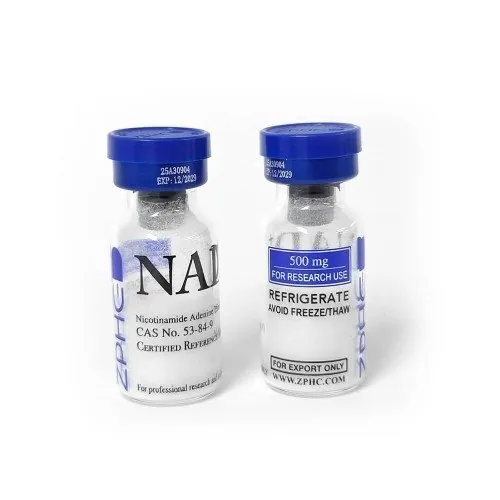
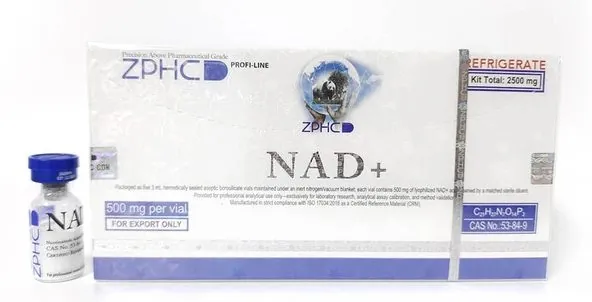
ZPHC NAD+ vials. Photo from open sources. The manufacturer is mentioned as an example, without any partnership.
Kits of powder vials with solvent, as well as "NAD+ AQ" — a ready-made solution in a pen injector. CAS 53-84-9 and the formula C₂₁H₂₇N₇O₁₄P₂ match NAD+. "Certified reference material", "for analytical use only", "for research only", "for export only". One of the boxes says: "Not for therapeutic use. This product has no medical purpose or action".
Using the unique code on the packaging, you can check on the ZPHC website (validation.zphc.com) that the product was made by ZPHC and is not a counterfeit of the brand. This protects against counterfeits but does not replace an analysis of the contents.
"Energy boost", "cell regeneration", "longevity support", "sterile formulation" — these are the sellers' words, not what the packaging says, which states the opposite.
Sterility is the main question specifically for NAD+. The documented problems with NAD+ in the US are endotoxins in solutions — and at pharmacies that the FDA inspects. The note "sealed under aseptic conditions" and the stated purity of ≥ 98.9% concern the substance content and are not the same as an independent endotoxin test. We could not find such a test for ZPHC NAD+ in the public domain.
The pen injector with a ready-made solution looks much closer to a medicinal product than laboratory powder, although the intended use on the packaging is the same. The quality of the contents is confirmed only by the manufacturer's own data — it is a matter of trusting the manufacturer.