What is it?
Glutathione is a small molecule made of three amino acids (glutamate, cysteine and glycine) that the body produces itself, mostly in the liver. It is present in almost every cell of the body and is often called the cell's "master antioxidant". Put simply, its job is to "neutralise" things — to disarm harmful oxidants formed during metabolism, to help the liver bind and eliminate some drugs and toxins, and to protect cell proteins and membranes from damage. Its level falls under heavy strain on the body, in a number of chronic diseases, in alcohol-related liver damage, in paracetamol poisoning and with age.
Class: tripeptide γ-L-glutamyl-L-cysteinylglycine; an endogenous human substance.
Formula / mass: C₁₀H₁₇N₃O₆S, ≈307 g/mol.[10]
CAS: reduced (active) form GSH — 70-18-8; oxidised form GSSG — 27025-41-8.[10]
Regulatory status: prescription medicine in Italy, Japan, Russia and the Philippines (narrow indications); dietary supplement in the US and EU; no approved injectable product in the US; "beauty", "detox" and "whitening" injections are not approved by any regulator.
Sport: the substance itself is not prohibited by WADA, but intravenous infusions of more than 100 ml per 12 hours are prohibited outside hospital treatment — regardless of what is being infused.[9]
Discovered: 1888; the name "glutathione" dates from 1921.
What is established and what is a separate question. That the body needs its own glutathione is a proven fact. Whether glutathione given from outside (as a tablet, inhalation, drip or injection) helps is a different question, and the answer differs for each form and each disease. It enters cells intact poorly: to a large extent it is broken down into amino acids, from which the cell then assembles its own glutathione. Most of its "antioxidant" work is done not by glutathione itself but as "fuel" for enzymes — glutathione peroxidases and glutathione S-transferases. An unusual bond between glutamate and cysteine protects the molecule from most protein-digesting enzymes.[10]
Tablets and capsules — standard, liposomal (in "fat bubbles") and a modified form, S-acetylglutathione, designed for better absorption.
Inhalations and nasal sprays — studied in lung diseases and Parkinson's disease.
Injections and drips — medicines in some countries; in "drip clinics" and in self-administration — often outside medical supervision.
Creams — cosmetics.
When did it appear?
What is it used for?
As a medicine (prescribed by a doctor)
Prevention of nerve damage during chemotherapy with cisplatin and similar drugs.[6]
The broadest list: drug poisonings, chronic liver diseases, eczema and dermatitis, urticaria, melasma and post-inflammatory skin darkening, severe vomiting in pregnancy, after-effects of radiotherapy; tablets are also available.[7] Melasma here is a medical indication treated by a doctor, not permission to "whiten" healthy skin.
A prescription powder for injections and drips: liver diseases (hepatitis, cirrhosis, fatty liver disease), drug-induced liver damage, reduction of chemotherapy toxicity.[8]
Only as an adjunct to cisplatin chemotherapy.[5]
As a dietary supplement. Manufacturers promise "antioxidant protection", "liver and immune support" and "glowing skin". These are manufacturers' claims, not proven medical effects.
In the US there is no approved glutathione medicine.[4] Injections there are made by pharmacies on individual prescriptions (pharmacy compounding): the FDA does not currently prohibit this, but has not approved it either. In 2022 an FDA advisory committee voted to allow pharmacies to work with glutathione — against the view of the FDA's own experts, who pointed to a lack of data; there is no final decision.[3][12]
Pharmacy medicine, supplement and a "research" vial — what is the difference
The molecule is the same, but these are three very different products.
| Pharmacy medicine (Tationil, Glathione, etc.) | Dietary supplement | "Research" vial (e.g. ZPHC) | |
|---|---|---|---|
| Who checks it | a government regulator | lighter oversight; efficacy is not checked | no one; everything is known only from the seller |
| Purpose | treating people for specific indications | oral use by healthy people | formally — for laboratories, "not for human use" |
| Sterility and purity | checked for every batch to mandatory standards | not intended for injection | claimed by the seller; no independent checks |
| Instructions | yes: indications, contraindications, side effects | a label with the ingredients | none; "instructions" come from forums and social media |
| Who prescribes it | a doctor, on prescription | sold freely | the buyer decides |
| If something goes wrong | adverse-event reporting system, batch recalls | limited | in practice, no one is responsible |
If approved medicines exist, why buy "research" vials?
The answer comes down to several practical reasons — and none of them is that such vials are better.
- In many countries there is simply no legal injection. In the US there is no approved medicine at all; in most EU countries glutathione is sold only as a supplement in tablet form. A person who specifically wants injections is left with a drip clinic, pharmacy compounding (where permitted) or the internet.
- A prescription is given only for a disease. Where the medicine exists, it is prescribed for specific conditions. The medicine has no such indications for "detox", "glowing skin" or post-workout recovery.
- Price. According to sellers, a set of vials containing several grams costs on the order of a few tens of dollars, while a single drip at an American clinic, according to the clinics themselves, usually costs 150–300 dollars.[36]
- Convenience and habit. The vial arrives by post and can be injected at home. Many buyers already get other "peptides" from the same sellers — glutathione simply goes into the same basket.
- Freedom in regimens. A vial has no instructions; the buyer chooses the regimen themselves — on the advice of the seller, a blogger or a forum. For some people this is a plus; from a safety point of view it is the main minus.
- The "for research" label allows sale without a prescription — formally, it is not a medicine for humans.
- Many people do not know there is a difference at all. The same CAS number, the same "99% purity" — it seems to be the same thing, only cheaper. The difference lies in sterility and endotoxin control, which cannot be seen from outside.
In other words, vials win on price, availability and freedom, and lose on what is hardest to check yourself — quality guarantees. More about the ZPHC product in the last section.
What people expect from it and why it is popular
Why it is so popular. Glutathione is "natural" — the body makes it itself — so many people assume that giving it must be safe by definition. The second reason is that it genuinely has a medical history and approved medicines, which lends credibility to cosmetic procedures as well, even though these are different things.
What has research shown?
How to read this section: the most reliable studies are those in which some participants receive a "dummy" (placebo) and nobody knows who got what. Studies without such a group and with few people deserve less trust.
Animal studies
In animal studies, glutathione has consistently been shown to protect the liver and other organs from a number of toxins (for example, from paracetamol overdose). In one study, glutathione injections reduced skin pigmentation without signs of organ damage.[32] But animals are not people: these studies do not settle the main question of benefit for humans.
Human studies: what looks encouraging
- Cisplatin and oxaliplatin chemotherapy. In a double-blind study of 151 women with ovarian cancer, glutathione reduced cisplatin toxicity (including to the kidneys), improved quality of life, and more patients were able to complete all six cycles of treatment — 58% vs 39%.[13] In 52 patients with colorectal cancer — less nerve damage from oxaliplatin without reducing the effectiveness of the chemotherapy itself.[14] The medicines in Italy, the Philippines and Russia are based on data like these.
- Skin (tablets and creams). A 2024 systematic review found five placebo-controlled studies in which glutathione tablets significantly reduced skin pigment content; creams also worked, and a combination of cream and tablets was better than either alone. The authors' caveat: the effect is moderate and does not persist after stopping.[17] In 30 women, a glutathione cream noticeably lightened the skin over 10 weeks compared with placebo, without marked side effects;[18] in middle-aged women, tablets improved a number of skin parameters, including wrinkles and elasticity.[19]
- Absorption of tablets. For a long time tablets were thought to be useless because glutathione is broken down in the gut. A study of 54 people showed that with daily intake over six months, glutathione stores in the blood and cells do increase.[21] Newer forms (for example, micellar) are absorbed better than the standard one.[22]
- Liver. In patients with non-alcoholic fatty liver disease, one of the liver blood markers (ALT) fell during tablet treatment; the study was small and had no placebo group.[23]
- Parkinson's disease. In a small study of 9 patients at an early stage, drips reduced symptoms for 2–4 months (no placebo group).[24] A pooled analysis of 7 studies (450 participants, including Chinese studies) showed a small improvement in motor symptoms.[25]
- Tolerability. In controlled studies, glutathione was generally well tolerated; serious side effects related to it were, as a rule, not reported.
Human studies: what was not confirmed
- Parkinson's disease in rigorous studies. When drips were compared with placebo (21 patients), there was no difference.[26] Nasal spray (45 patients, 3 months): improvement occurred in all groups, including placebo, and glutathione did not outperform it.[27] A recent 2026 review calls the data preliminary.[28]
- Other chemotherapy regimens. In a study of 185 patients on paclitaxel plus carboplatin, glutathione did not protect the nerves;[15] the American Society of Clinical Oncology (ASCO) does not recommend it for this regimen.[16] Conclusion: a result for one drug cannot be transferred to another.
- Cystic fibrosis. In the largest study (153 patients, six months of inhalations) there was no noticeable improvement.[29]
- Drips for skin lightening. The only placebo-controlled study (Pakistan, 2016): after 12 drips, the skin lightened in 37.5% of those receiving glutathione vs 18.7% in the placebo group, but six months later the effect persisted in only 6.2%; side effects were reported, including abdominal pain and an anaphylactic reaction. The authors concluded that drips are of little use for skin lightening.[20]
Skin: tablets and creams — a moderate, temporary effect; drips — little data, and not in their favour. Parkinson's disease: there are some positive signals, but the most rigorous studies show no advantage over placebo. Chemotherapy: the benefit depends on the specific drug — present with cisplatin and oxaliplatin, absent with paclitaxel plus carboplatin. For "detox", rejuvenation and hangovers in healthy people there are no studies with convincing results.
What people who have used it say
Personal experience is not proof: a person does not know what would have happened without glutathione and often changes many other things at the same time. Below are Reddit posts (checked manually) and YouTube videos. Only three of the videos are accounts by people who injected themselves; the opinions of doctors and specialists are collected separately below.
Intramuscular injections prescribed by a doctor. Bodybuilder and sports nutrition company owner Marc Lobliner had an injection after a hard leg workout and the next day felt that his muscles were hardly sore; about an hour after the injection, he says, he had "more energy". Caveats: he was preparing for a competition, when athletes usually use many other substances, and in the same video he advertises his own products. He himself warns against buying glutathione from veterinary websites and advises getting it through a doctor.[40]
A year of injections at home. A health blogger injected herself for about a year and believes the injections supported her immunity: when she stopped, she fell seriously ill with mononucleosis. The link is her personal assumption.[41]
Drips for the skin. r/skinwhitening, July 2024: "before/after" photos after a course of drips at an Indian clinic. The author himself calls the changes "very subtle but noticeable" and writes that the photos are edited and that lighting changes the impression a lot.[37]
A first injection from a "peptide" vial — the same type of product as ZPHC's. The blogger shows the vials arriving on ice and gives herself a first injection in the abdomen: painless, she says. No results yet. Telling details: she found the seller's regimen too intensive and decided to inject less often — the buyer makes the decisions; and she is using two other substances at the same time (tirzepatide and NAD+), so it will be impossible to tell what any effect comes from.[42]
A course of drips with no result. r/TwoXIndia, February 2026: after two of the ten prescribed drips (plus tablets) there is no change. The doctor promises results after 3–6 sessions and an effect lasting a year or two; the author finds data on a much shorter effect.[38]
Skin lightening as an unwanted effect. The same blogger who injected for a year started injecting less often: her skin became lighter and noticeably more sensitive to the sun. This is consistent with glutathione reducing production of the protective pigment. The second reason was that daily injections are simply tiring.[41]
Patchy skin. r/glutathione, around May 2025: a question about whether drips can cause an uneven complexion — lighter and darker areas.[39]
What doctors and specialists say in videos
The authors' personal opinions, not clinical recommendations.
Tablets and creams have been studied in small trials: there were no serious side effects, but the effect was modest. On drips, she cites the only placebo-controlled study, in which the lightening had almost disappeared by six months (see "What has research shown?"). Her conclusion: better to avoid drips. Caveat: in the same video she praises a cosmetic product containing glutathione.
Injections, inhalations and sprays — only as prescribed by a doctor. Among tablets, in her opinion, it makes sense to buy the liposomal form and S-acetylglutathione; ordinary powder is barely absorbed.
Explains why glutathione is popular with athletes: they inject it to protect the liver during cycles of oral steroids. Three sober points: injecting "into the target muscle" for a local effect is pointless — the substance quickly spreads through the body; a strong antioxidant right after training may blunt its benefits; and a cheaper alternative is N-acetylcysteine (NAC), from which the body makes glutathione itself. He honestly admits that there are no data on dosing regimens.
An admission from the industry itself: the clinic uses only Italian approved products and does not use a cheaper Chinese one because it is "not sure about the quality". It lists cancer, age under 18 and pregnancy among the contraindications.
People who inject are most often impressed by quick sensations — "more energy", "easier recovery". But these are sensations against a background of other life changes, without comparison with placebo. An unexpected side effect mentioned by users themselves is lighter skin and sensitivity to the sun. And almost every video shows the same problem: people choose regimens and combinations themselves or on the seller's advice.
Possible effects
Possible risks
Documented
Poor-quality injections are the main risk. US, 2026: at least 30 people were affected (FDA data as of 27.08.2026), with cases in at least four states (Texas, Washington, Florida, New York) after intravenous, subcutaneous and intramuscular injections; at least three were hospitalised, one in intensive care with shock and a blood-clotting disorder. All the implicated injections were made by pharmacies from glutathione intended for dietary supplements; three pharmacies in Texas recalled their products. Symptoms: fever, chills, body aches, headache, nausea, dizziness, low blood pressure.[4][1]
US, 2019: a similar story — patients with severe reactions, one hospitalised; the raw material contained many times the permitted level of endotoxins.[2]
Australia, 2015: 7 people with probable endotoxin poisoning after drips; most were receiving them "for Lyme disease"; the cause was a batch of powder from a new overseas supplier.[33]
Severe skin reactions. The Philippine regulator warns that "whitening" injections can damage the liver, kidneys and nervous system and cause Stevens–Johnson syndrome — a severe reaction with skin peeling.[5] A described case is in the "Individual clinical cases" section.
Inhalations in asthma. In a small study of people with mild asthma, inhaled glutathione caused marked narrowing of the airways, coughing and breathlessness — probably because of sulphite formation.[30]
General risks of injections outside hospital: infections, vein inflammation, allergic reactions.
Theoretical and reported by users
Cancer. Tumours also use glutathione to protect themselves from drugs, so there is concern that with some chemotherapy regimens it may reduce their effectiveness. The Russian prescribing information includes restrictions on combining it with cisplatin.[8] Only at an oncologist's discretion.
Lighter skin and sun sensitivity. For those who want to lighten their skin this is the goal; for everyone else it is a side effect: users who injected for a long time report that their skin became lighter and burns more easily. This is personal experience, but it is consistent with glutathione reducing production of the protective pigment.
For athletes. In a 2009 study, high doses of antioxidants (vitamins C and E) during a month-long training programme blunted some of its benefits — for example, the increase in insulin sensitivity.[31] This has not been tested for glutathione, and not all researchers agree with that study's conclusions.
Long-term consequences of "whitening". The Philippine regulator mentions a theoretical concern about skin cancer with prolonged suppression of pigment;[5] there are no data either for or against.
Even peptides that have completed full clinical trials and are sold as medicines have side effects related specifically to injections. For example, for tirzepatide (Mounjaro, Zepbound), according to the FDA label:[49][50][51]
- injection-site reactions (redness, itching, induration): 3.2% vs 0.4% on placebo;
- allergic reactions: 3.2% vs 1.7% on placebo; rare cases of anaphylaxis and angioedema have been described after market launch;
- antibodies to the drug: developed in 51% of trial participants. These participants had injection-site reactions and allergies more often.
For an approved medicine, these risks have been measured in thousands of people, and manufacturing is overseen by a regulator. No such data exist for glutathione, so the frequency of such reactions is unknown. On top of that come the risks of unlicensed manufacturing: contamination, errors in the amount of substance, lack of sterility. More on the tirzepatide page →
Contraindications / who should be especially cautious
Unlike the other peptides on this site, glutathione has official prescribing information for medicines — the source of each point is given below.
- Pregnancy and breastfeeding — the Russian prescribing information prohibits use,[8] the Italian one advises against it.[6]
- Children — the Russian prescribing information prohibits use; in Italy, safety in children has not been established.
- Asthma — caution with inhalations (risk of airway narrowing).[30]
- Chemotherapy — only at an oncologist's discretion.
- Allergy to the ingredients — a standard contraindication.
- Athletes — drips of more than 100 ml per 12 hours violate anti-doping rules.[9]
Individual clinical cases
A man with Parkinson's disease: with standard treatment plus additional glutathione drips, both subjective and measured symptoms decreased.[35] Caveats: one patient, an article in an alternative medicine journal, and he was receiving other treatment at the same time.
A 33-year-old woman: Stevens–Johnson syndrome after a drip containing glutathione and vitamins C and D at a wellness centre. It cannot be proven that glutathione specifically was to blame, but the authors consider it the likely cause.[34]
ZPHC products: what we could verify
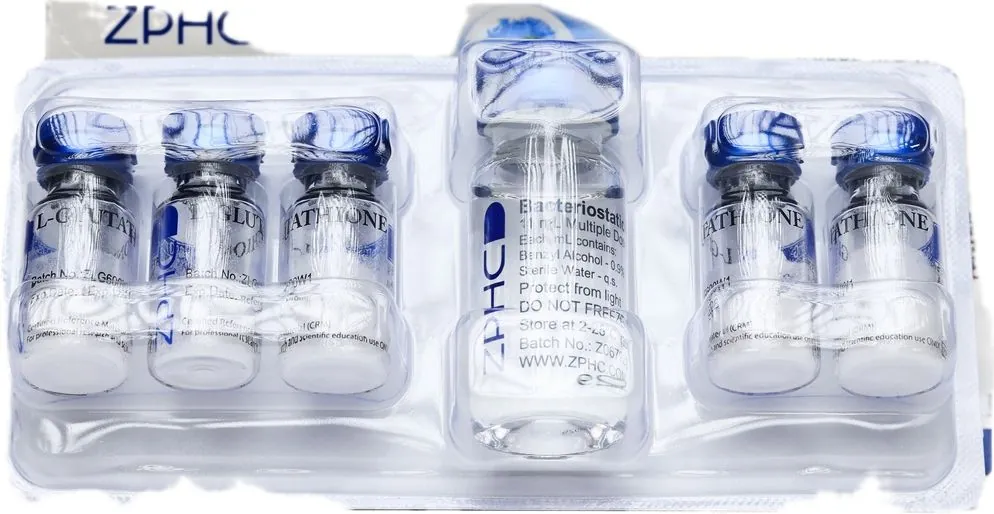
Five vials of powder and a vial of solvent with benzyl alcohol. Photo from open sources.
The manufacturer ZPHC is used on this site as an illustrative example, without any partnership.
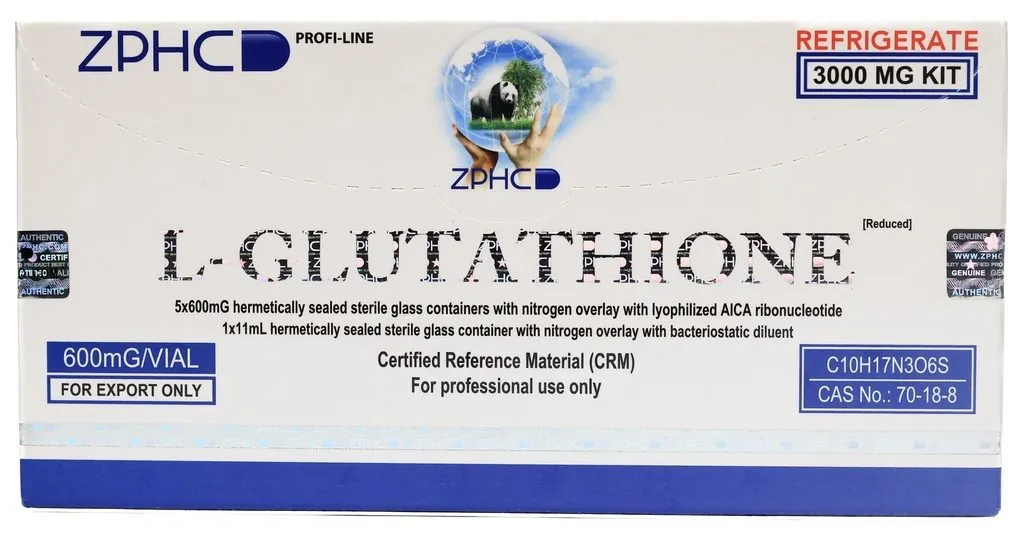
L-Glutathione (Reduced), formula C₁₀H₁₇N₃O₆S and CAS 70-18-8 — these match reduced glutathione; 3000 mg kit: 5 vials of 600 mg + 11 ml of solvent; "Certified Reference Material (CRM)", "For professional use only", "For export only", "Refrigerate".
A seller describing itself as an official ZPHC dealer claims purity of at least 99%, sterility and endotoxin testing, and a security code on the packaging; the product is listed in the "Anti-ageing / longevity" section. All of this is according to the seller.
A contradiction in intended use. A "reference material" is a sample for laboratory measurements, not a medicine for people. Yet the same product is sold with a solvent for injection in the "anti-ageing" section.
A misprint in the composition on the box. The front of the packaging describes the vials as containing "lyophilized AICA ribonucleotide" — a different substance (AICAR), not glutathione. Most likely the text was carried over from another product's packaging, but the fact itself shows how carefully the labelling is checked.
No independent analyses. We could not find any independent public analyses of ZPHC glutathione — including for endotoxins. This does not mean the product is bad, but it does mean its quality is known only from the seller. For glutathione, endotoxins are precisely the main documented risk.