What is it?
BPC-157 (Body Protection Compound-157) is a synthetic pentadecapeptide — a short chain of 15 amino acids. Its sequence is based on a fragment of a protein that researchers reported finding in human gastric juice — hence the name.
The most studied mechanism (in preclinical research) is its effect on the nitric oxide (NO) system: the peptide increases expression of NO synthase and also stimulates the VEGFR2 receptor, which promotes the formation of new blood vessels (angiogenesis) and tissue healing. Other pathways have also been described — effects on the serotonin and dopamine systems, antioxidant activity, COX-2 and prostaglandins.[1] [2]
When did it appear?
Supporters of lighter regulation (including part of the MAHA movement) make a separate point: in their view, overly strict restrictions hold back scientific progress by preventing the substance from going through proper controlled trials that could show its real efficacy and safety faster and more accurately.
Sources for this section: [4] [3] [6] [7] [16] [17] [18] [20]
What is it used for?
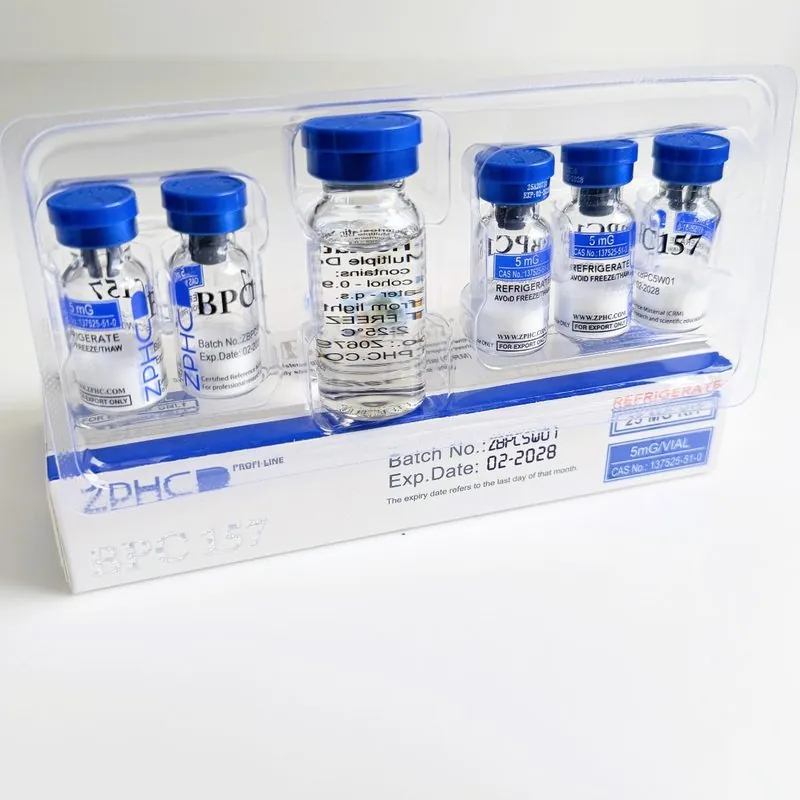
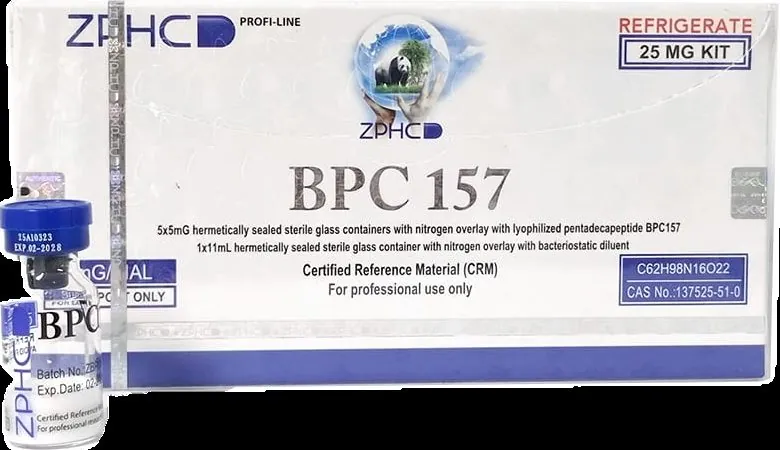
Close-up of BPC-157 vials — the label shows the CAS number, PubChem CID and the note "Certified Reference Material".
The packaging states that the product is a "Certified Reference Material" and cites EU 2017/746 and MEDDEV 2.14/2. This is the manufacturer's label, not a fact we have verified: Regulation (EU) 2017/746 covers in vitro diagnostic devices, not reference materials. The key point of the label is that the manufacturer officially declares a research purpose, not a medical one. Source: photo of the packaging (for information purposes).
This is no longer the manufacturer's position from the label but a seller's marketing text — these claims have not been confirmed by clinical trials in humans.[10]
The scientific and sports communities discuss BPC-157 in the context of: recovery of tendons, ligaments and muscles after injury; healing of the gastrointestinal lining; and generally faster recovery after physical exertion.[1][2][8]
What people expect from it and why it is popular
The main expectation is faster recovery from injuries and exertion: tendons, ligaments, muscles, joints. Its popularity has several drivers: an extensive body of animal research with promising results; active promotion in sports and bodybuilding circles since the 2010s through the grey market; in 2025–2026, noticeable attention from some wellness influencers and the MAHA movement ("Make America Healthy Again" — a US socio-political movement for health and food reform); and a handful of striking personal stories.
What has research shown?
Animal studies
These make up the vast majority of existing data — dozens of studies, almost all in rats and rabbits:
- Healing of wounds and ulcers. Models of burn and alkali injuries and gastric ulcers — faster epithelialisation, collagen formation and neovascularisation.[1]
- Tendons, ligaments, muscles, bones. Improved functional and structural measures of Achilles tendon healing.[1][8][11]
- Protection of the GI tract and liver in alcohol-induced damage. Fewer lesions with chronic ethanol administration, fewer withdrawal symptoms.[1]
- Cancer cachexia. A significant improvement in the animals' overall body weight, but without a statistically significant reduction in tumour volume — an important distinction between "relieving a symptom" and "an anti-tumour effect".[1]
- Central nervous system. Models of stroke/ischaemia, spinal cord injury and schizophrenia-like symptoms — a positive effect relative to controls is reported in all cases.[2]
A 2025 systematic review (36 studies, 1993–2024) counted 35 preclinical studies and only 1 clinical study, rating the overall level of evidence as low (Level IV–V).[8]
Human studies
Human data are extremely scarce, and every review cited here acknowledges this:
- A retrospective series on knee pain (Lee, 2021, Institute for Hormonal Balance, published in Alternative Therapies in Health and Medicine): only 17 patients, of whom 16 were reached for follow-up. Of these, 12 received BPC-157 alone by intra-articular injection — 11 of 12 (91.6%) improved immediately after the injection, but the effect lasted longer than 6 months in only 7 of 12. Another 4 patients received BPC-157 together with TB-500 (3 of 4 improved). In total, 14 of 16 (87.5%) reported relief. No control group and no validated pain scales.[1][8][14]
- Phase I/Ib (NCT02637284): registered in 2015; oral PCO-02 tablets (1 mg BPC-157); healthy volunteers aged 18–35; a single site — Hospital Angeles in Tijuana (Mexico); sponsor PharmaCotherapia d.o.o. On ClinicalTrials.gov the status is "Unknown status" (the sponsor stopped updating the record) and the results have never been published. This is not a trial "withdrawn in 2016", as is sometimes claimed — the registry entry was simply never updated.[4][5][15]
- A pilot safety study of intravenous administration (Lee & Burgess) — the first published data on tolerability by the intravenous route.[12]
- Early enema trials in ulcerative colitis (PLIVA, ~2003) — mixed results, never fully published anywhere.[4]
- A new controlled trial. In 2026, NCT07437547 (BPC-HAMSTR) began — the first randomised, double-blind, placebo-controlled trial (Phase 2, 120 participants, acute grade II hamstring strain), sponsored by Hudson (Tianjin) Biotechnology. Recruitment started in February 2026; primary completion is expected in early 2027.[19]
Other research and observations
- There are about 200 publications on BPC-157 in PubMed, the vast majority from the same Croatian group led by Sikirić; researchers in Poland and Canada (McGill) describe this as a problem for independent verification.[4][5]
- The patent does not state the exact molecular weight or the full sequence of the source protein — so the original source cannot be independently reproduced from the patent.[4]
- One of the co-authors of the early work, Sandor Szabo, allows that "the team may have misinterpreted the amino acid sequence many years ago".[4]
What people who have used it say
An anonymous Reddit user with hypermobility syndrome reported that chronic pain disappeared after more than a year of use. Ryan Beattie links its use to less pain and less dependence on opioid painkillers. On the MESO-Rx forum: an "incredible" result for a shoulder, and knee pain resolved for 10+ months.
On the MESO-Rx forum, several members describe only a moderate anti-inflammatory effect — "not a miracle drug"; in their words, the result depends heavily on the dose, and at low doses many describe the effect as negligible.
The author of a MESO-Rx thread tried several ways of taking it and noticed no benefit for shoulder pain, knee pain or "tennis elbow". According to STAT News, some Reddit users reported pronounced adverse effects: severe itching all over the body, severe anxiety with hallucinations, and anhedonia.
Note: these are accounts from ordinary users in open sources — whether to believe them is up to each reader; they are not clinical data. We have not found any published formal clinical case reports of harm from BPC-157 in humans — only the user reports above and the FDA's general regulatory caution (see below).
Possible effects
Based on the overall preclinical data and user claims (none of these effects has been confirmed by controlled human studies): faster healing of tendons, ligaments, muscles and the GI lining; an anti-inflammatory effect; a possible neuroprotective effect (in animal models only); and stimulation of new blood vessel formation — an effect that is both "useful" (it speeds up healing) and potentially risky: in theory, accelerated angiogenesis could feed an existing, not-yet-diagnosed tumour, but in practice no such cases have been recorded in humans — for now this is a theoretical, not a confirmed, danger.[1]
Possible risks
The FDA's official position (2023): the agency pointed to immunogenicity with certain routes of administration and difficulties in characterising impurities, and stated directly that it "lacks sufficient information to know whether the drug would cause harm when administered to humans".[7]
Theoretical risk from angiogenesis: the same mechanism that promotes healing could, in theory, speed up the blood supply to undiagnosed tumours; Sikirić's team disputes this risk.[1][4]
Oxidative stress: when oxidised, the metabolite proline can form cytotoxic peroxynitrite; in theory this has been linked to cardiovascular and neurodegenerative risks.[1]
Origin of the product: the vast majority of products are sold outside the pharmacy system, often through the grey market — with a risk that the actual composition does not match the label, of impurities and of inconsistent quality.[4][5]
Long-term effects are unknown — no study has assessed the effects of regular use over many years.[4]
These risks should be weighed against the scale of use. Indirect estimates (number of sellers, forum activity, search demand) suggest that on the order of several hundred thousand people worldwide use BPC-157 — which corresponds roughly to tens of millions of doses per year. At that volume, only isolated serious cases have been officially documented and not a single confirmed death — this alone does not prove safety (the substance is sold outside the prescription system, and most cases simply never reach any official register), but neither does it support the idea of widespread, systematic harm. Only future controlled studies can give a definitive answer as to which of the two explanations is correct.
Even peptides that have completed full clinical trials and are sold as medicines have side effects related specifically to injections. For example, for tirzepatide (Mounjaro, Zepbound), according to the FDA label:[23][24][25]
- injection-site reactions (redness, itching, induration): 3.2% vs 0.4% on placebo;
- allergic reactions: 3.2% vs 1.7% on placebo; rare cases of anaphylaxis and angioedema have been described after market launch;
- anti-drug antibodies: developed in 51% of trial participants. These participants had injection-site reactions and allergies more often.
For an approved medicine, these risks have been measured in thousands of people, and manufacturing is overseen by a regulator. No such data exist for BPC-157, so the frequency of such reactions is unknown. On top of that come the risks of unlicensed manufacturing: contamination, errors in the amount of substance, lack of sterility. More on the tirzepatide page →
Contraindications / who should be especially cautious
- People with active cancer or undiagnosed tumours — because of the theoretical risk associated with stimulating angiogenesis.
- Pregnant and breastfeeding women — there are no safety data at all.
- Children — there are no data, and no source considers use in children.
- Athletes subject to doping control (WADA/USADA) and US military personnel — the substance is prohibited for these groups.
- People for whom a guarantee of the product's composition and purity is essential — given that the vast majority of products are sold outside pharmacy control.
- Residents of Australia — possession without a prescription is an offence there (Schedule 4, Appendix D); in most other countries there is no formal ban on possession, but selling it as a medicine without authorisation is illegal almost everywhere.[17][21]
- Anyone considering use — it is important to bear in mind that neither doses, nor regimens, nor duration of use have been established in any controlled human study.
Individual clinical cases
A retrospective series on knee pain (Lee, 2021): most of the 16 patients surveyed reported pain relief (14 of 16, 87.5%), and in some the effect lasted longer than 6 months. Limitations: no control group, a retrospective assessment, no validated pain scales.[1][8][14]
The FDA's 2023 decision to remove BPC-157 from the list of substances eligible for pharmacy compounding — in effect, an official acknowledgement that the agency did not have enough data to rule out harm to humans. Formally, this restriction was lifted in April 2026 (see the timeline above), but it was not replaced by an approval — the substance remains in a regulatory "grey zone".[7][22]
Reports from Reddit users of severe anxiety with hallucinations, anhedonia and generalised itching after taking BPC-157, documented in a STAT News article; not independently verified by medical professionals.[4]